
I. Introduction: Why Is Crypto Paying Attention to SKHYB?
In 2026, crypto users are no longer focused solely on BTC, ETH, meme coins, and DeFi tokens. An increasing number of traditional financial assets are entering the crypto market via blockchain. Stocks, ETFs, gold, government bonds, and funds are being packaged as on-chain tokens or derivatives, forming the RWA (Real World Asset) tokenization track.
SKHYB is one of the representative assets emerging from this trend.
Many newcomers have a question when they first see SKHYB: Why would the stock of a Korean chip company appear on a crypto trading platform? Is it a stock or a cryptocurrency? Can it be traded with USDT like BTC/USDT? And what is its relationship with SKHYNIXUSDT?
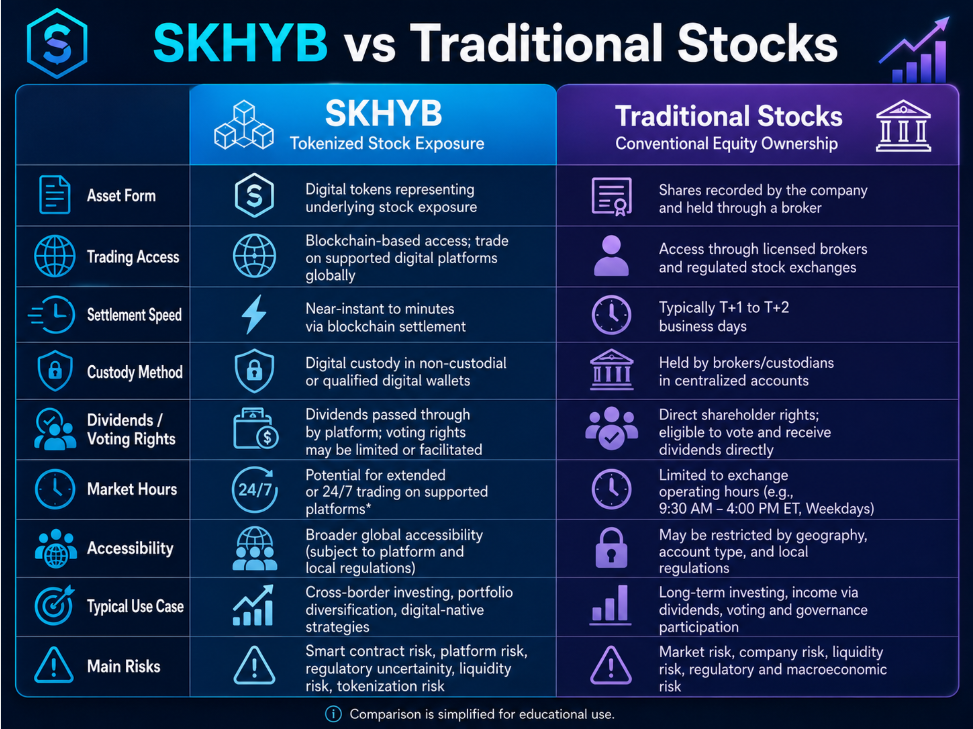
Simply put, SKHYB is not a "SK Hynix stock held in a traditional brokerage account" in the conventional sense. Instead, it is a tokenized security product designed around the price exposure of SK Hynix stock. According to a Binance announcement, SKHYB belongs to the bStocks tokenized securities category, issued by BTech Holdings Limited, and represents an interest in the underlying security but does not equate to direct ownership of the underlying listed company stock. SKHYB/USDT spot trading opened on July 13, 2026, at 13:30 UTC. The announcement also emphasized that bStocks are not stocks or shares, and holders do not directly own the underlying listed company stock.
This is the first key point to understanding SKHYB: It is not a stock issued by SK Hynix itself, nor is it an ordinary altcoin. It is a financial wrapper that brings a traditional stock asset into an on-chain trading environment.
1.1 What Is SKHYB? Understanding It in One Sentence
SKHYB can be understood as:
SK Hynix Tokenized bStocks, an on-chain tokenized security product tied to the price exposure of SK Hynix stock.
Its core is not to create a brand-new blockchain project, nor does it derive value from network consensus like BTC. Instead, it maps the price performance of a traditional stock asset into the crypto market, allowing eligible users to participate in related trading through crypto assets like USDT.
More colloquially:
The traditional stock investment path is:
Brokerage Account ↓ Stock Exchange ↓ Buy SK Hynix Stock
The SKHYB path is:
Crypto Trading Account ↓ USDT ↓ Buy SK Hynix Tokenized Security
This is why SKHYB has captured the attention of crypto users: it has moved the traditional stock investment entry point into a crypto trading scenario.
1.2 Why Is the AI Era Making SK Hynix a Focus?
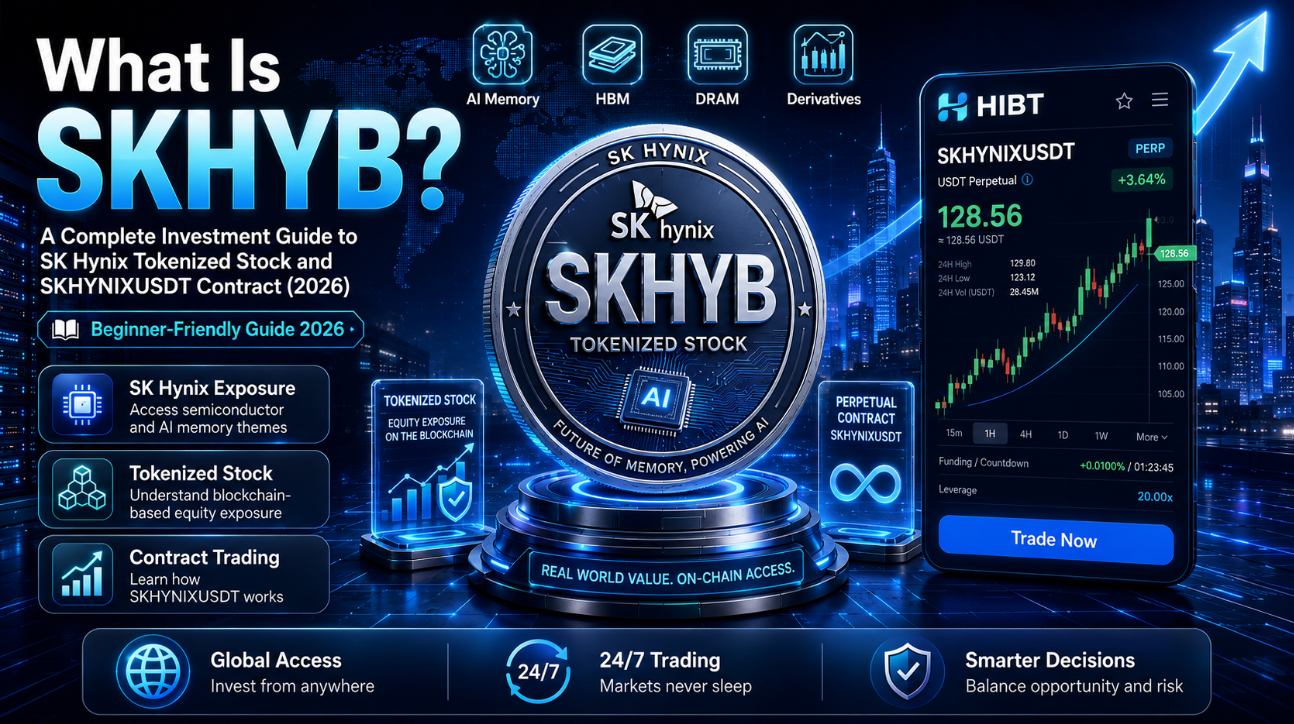
SK Hynix is not an ordinary chip company. It is a major global memory semiconductor enterprise, with core products including DRAM, NAND flash, and HBM (High Bandwidth Memory). SK Hynix's official materials also position the company as a key player in the global memory semiconductor industry, driving digital infrastructure development through high-performance memory solutions.
In the past, many newcomers to AI investing only thought of NVIDIA, GPUs, AI models, and large-model applications. However, what truly supports AI computing power is not a single chip, but an entire hardware supply chain:
AI Model Training and Inference ↓ Requires GPUs / AI Accelerators ↓ GPUs Need High-Performance Memory ↓ HBM Becomes a Key Component ↓ SK Hynix Becomes a Critical Participant in the AI Infrastructure Supply Chain
HBM, or High Bandwidth Memory, is better suited for high-throughput, high-bandwidth, high-density AI computing scenarios compared to standard memory. Large model training, AI servers, and data center GPU clusters all require stronger memory bandwidth support.
In its 2025 financial report, SK Hynix stated that the company achieved record annual results, with full-year revenue of 97.1467 trillion KRW and operating profit of 47.2063 trillion KRW. The performance growth was driven by the competitiveness of its AI memory and high-value-added products including HBM. The company also noted that HBM revenue more than doubled year-over-year.
This is the fundamental reason SK Hynix is in the spotlight: it is not simply selling ordinary memory, but is positioned at the "memory bottleneck" behind the expansion of AI computing power.
1.3 What Is the Difference Between SKHYB and Ordinary Crypto?
Many newcomers see SKHYB listed on a crypto trading platform and easily mistake it for an ordinary cryptocurrency. However, the underlying logic of SKHYB is completely different from assets like BTC, ETH, and SUSHI.
BTC and ETH are blockchain-native assets. Their value primarily comes from the blockchain network itself, including network consensus, on-chain usage demand, ecosystem applications, transaction fees, developer activity, and market recognition of the public chain's long-term value. When investing in BTC and ETH, users focus on the crypto market cycle, macro liquidity, on-chain data, the regulatory environment, and technological upgrades.
Assets like SUSHI are DeFi Tokens. They correspond to decentralized exchange protocols, and their value derives more from protocol revenue, governance mechanisms, liquidity incentives, trading volume, and user adoption. When evaluating such tokens, one cannot look at price alone; one must also examine protocol TVL, DEX trading volume, fee revenue, governance efficiency, and competition among similar DeFi protocols.
SKHYB, on the other hand, falls under the RWA or tokenized stock category. It is not a blockchain-native asset, nor is it a DeFi protocol token. It is a tokenized asset designed around the price exposure of SK Hynix stock. Its core value does not come from the usage demand of a specific chain or the revenue of a DeFi protocol, but from the price performance of SK Hynix stock, the issuer's structure, the underlying asset custody mechanism, and market demand for trading tokenized stocks.
Therefore, the risks of SKHYB are also different from those of ordinary cryptocurrencies. BTC and ETH primarily face market cycle, regulatory, and technological risks. SUSHI primarily faces protocol competition, TVL decline, and governance risks. SKHYB, in addition to bearing the price volatility of SK Hynix stock itself, must also face additional issuer risk, custody risk, liquidity risk, redemption mechanism risk, and regulatory uncertainty.
Simply put:
BTC and ETH are about blockchain network value; SUSHI is about DeFi protocol value; SKHYB is about SK Hynix stock exposure and the structural security of the RWA product.
Therefore, when researching SKHYB, users cannot use the same methods as analyzing altcoins. In addition to looking at the trading price, they must also focus on confirming who issued it, how the underlying assets are custodied, whether redemption is supported, whether trading liquidity is sufficient, and whether the region allows participation in such tokenized stock products.
So, SKHYB is not "the next meme coin," nor is it "an official token from SK Hynix." It is closer to an on-chain traditional stock exposure product.
If you want to first understand the difference between DeFi tokens and tokenized stock assets, you can read: What Is SUSHI?
II. What Is SK Hynix? Why Has It Become an AI Chip Investment Target?
Investing in SKHYB is essentially not about investing in a new public chain or a DeFi protocol, but about gaining price exposure related to SK Hynix. Therefore, before understanding SKHYB, one must first understand the company SK Hynix.
2.1 What Kind of Company Is SK Hynix?
SK Hynix is a major South Korean semiconductor enterprise and one of the world's leading memory chip manufacturers. Its core business can be divided into three categories:
The first is DRAM. DRAM is widely used in PCs, mobile phones, servers, data centers, and other devices, and is a very core memory product in computing systems.
The second is NAND flash. NAND is mainly used in SSDs, storage devices, enterprise-level storage systems, and other scenarios. As the scale of AI data centers expands, demand for enterprise SSDs and high-performance storage is also growing.
The third is HBM (High Bandwidth Memory). This is SK Hynix's most closely watched business in the AI era. HBM primarily serves AI GPUs, large model training, AI inference servers, high-performance computing, and other scenarios.
In its 2025 financial report, SK Hynix mentioned that under an AI-centric demand structure, the company achieved growth and improved profitability by enhancing technological competitiveness and expanding its high-value-added product portfolio. HBM, server DRAM, NAND, and eSSD were all cited as important growth directions.
2.2 Why Has HBM Become a Core Asset in the AI Era?
The first layer of AI investing is models, the second is computing power, and the third is the computing power supply chain.
Many investors only focus on GPUs, but for an AI server to actually run, it requires not just the GPU chip itself, but also the joint support of memory, storage, networking, power, and cooling infrastructure. The reason HBM is important is that AI computing is very sensitive to memory bandwidth.
It can be understood this way:
Ordinary computing is like "one person solving a problem." AI large model training is like "tens of thousands of people solving problems simultaneously." GPUs are responsible for the computing. HBM is responsible for making data flow at high speed.
If the speed of data flow cannot keep up, even the most powerful GPUs will be slowed down by memory bandwidth. Therefore, in AI servers, HBM is not an optional accessory, but an important component affecting overall performance.
In its 2026 market outlook, SK Hynix mentioned that the global semiconductor industry is entering a structural adjustment period due to AI infrastructure expansion, with memory semiconductors becoming an important driver of demand and profitability. The report also cited market institution views, estimating the 2026 semiconductor market to be close to $975 billion, with the memory market growing by approximately 30%.
This shows that AI does not only benefit NVIDIA, but also benefits its upstream and supporting supply chains.
2.3 What Is the Relationship Between SK Hynix and NVIDIA?
The core AI investment logic of SK Hynix is inseparable from NVIDIA.
In June 2026, NVIDIA and SK Hynix announced a multi-year technology partnership. The two parties will jointly advance next-generation memory for AI factories and support NVIDIA's AI infrastructure roadmap. An NVIDIA press release explicitly mentioned that SK Hynix will co-develop memory for the NVIDIA Vera Rubin AI supercomputer, Vera CPU, RTX Spark PC, and Jetson Thor robotics computing platform.
This means that SK Hynix is not just a simple memory manufacturer, but one of the key memory partners in NVIDIA's AI infrastructure expansion.
Therefore, buying SKHYB is not the same as directly buying NVIDIA, but from an investment logic perspective, it can be understood as a way to "indirectly participate in the AI hardware supply chain." It is more oriented towards the upstream of AI infrastructure, rather than the AI application layer.
III. What Exactly Is SKHYB? A Detailed Explanation of the Tokenized Stock Mechanism
The question newcomers are most likely to get wrong is: Does buying SKHYB mean buying SK Hynix stock?
The answer is: No.
More accurately, SKHYB is a tokenized security product designed around the underlying securities of SK Hynix, providing related price exposure, but it does not equate to directly holding SK Hynix stock. A Binance announcement explicitly states that bStocks represent an interest in the underlying security, but are not direct ownership of the underlying listed company stock, nor do they represent an affiliation with the issuer of the underlying asset.
3.1 What Is a Tokenized Stock?
Tokenized Stock, often called "tokenized stock" or "stock tokenization asset" in Chinese.
Its basic logic is:
Underlying Stock or Security ↓ Held by Issuer, Custodian, or Brokerage Structure ↓ Issue On-Chain Token or Certificate-Type Asset ↓ User Trades on Crypto Platform
The goal of tokenized stocks is to bring traditional securities assets into the blockchain system, allowing users to gain stock price exposure in a trading environment closer to Crypto.
It may bring several advantages:
First, the trading entry point is closer to the habits of crypto users. Users can participate with digital assets like USDT without necessarily needing a traditional securities account.
Second, trading hours may be more flexible. Some platforms support 24-hour trading, but actual price tracking, liquidity, and risk control mechanisms are affected by stock market opening and closing times.
Third, it can be combined with wallets, on-chain assets, and DeFi infrastructure. This is also the reason the RWA track has been favored for the long term.
But it must be noted: tokenized stocks are not simply moving stocks onto the chain. Behind them lie complex issues involving the issuing entity, compliance region, custody arrangements, redemption rules, trading eligibility, and regulatory restrictions.
3.2 What Is the Relationship Between SKHYB and SK Hynix Stock?
The relationship between SKHYB and SK Hynix stock can be summarized in one sentence:
SKHYB provides economic exposure related to SK Hynix stock, but it does not mean you directly own SK Hynix stock.
In a traditional stock account, after an investor buys stock, they hold the equity of the stock in their securities account. In a product like SKHYB, the user holds a tokenized security or related certificate-type asset, and the specific rights depend on the issuer and platform rules.
A Binance announcement shows that SKHYB belongs to the bStocks tokenized securities category, involving related underlying securities interests, but does not directly grant the holder direct ownership of the underlying listed company stock. At the same time, trading eligibility is also subject to regional compliance restrictions.
Therefore, newcomers cannot just look at "the price looks like a stock." They must also look at three questions:
First, who issued it? The issuer mentioned in the SKHYB announcement is BTech Holdings Limited.
Second, how are the underlying assets custodied? Different platforms and product structures vary. Some have underlying securities arranged by the issuer, broker, or custodian, while others are synthetic derivatives that may not correspond to physical stock holdings.
Third, does the user have rights such as redemption, dividends, or conversion? These cannot be judged by the name alone; they must be based on the specific product terms of the platform.
3.3 Are SKHYB, SKHY, and SKHYx the Same Thing?
Here, newcomers must be especially warned: different platforms may use similar but not identical names.
For example:
SKHYB: Commonly seen in bStocks SK Hynix tokenized security trading pairs. SKHYx: The SK hynix xStock product symbol displayed on the Backed Assets page. The Backed page states that SKHYx is a freely transferable tracking certificate issued on a specific blockchain to track the price of SK hynix Inc. SKHYNIXUSDT or SKHYUSDT: More commonly seen in stock index perpetual contracts or derivative trading.
Therefore, when searching, users should note:
Similar names do not mean the same issuer. Price correlation does not mean the same rights structure. Being tradable does not mean it equals holding the stock.
IV. What Is SKHYNIXUSDT? Why Do Stock/USDT Trading Pairs Exist?
If SKHYB is closer to a "tokenized stock / tokenized security," then SKHYNIXUSDT is usually closer to a "USDT-margined contract or trading pair related to stock price."
These two must be understood separately.
4.1 What Does SKHYNIXUSDT Mean?
SKHYNIXUSDT can be split into two parts:
SKHYNIX: Represents the SK Hynix-related underlying asset. USDT: Represents the quote or margin currency.
It is similar in form to BTC/USDT and ETH/USDT, but the underlying logic is different.
BTC/USDT trades Bitcoin. ETH/USDT trades Ethereum. SKHYNIXUSDT usually does not trade "real SK Hynix stock," but rather derivatives, index contracts, or trading products defined by the platform that are related to SK Hynix's price performance.
For example, KuCoin announced on July 13, 2026, that it would launch the SKHYUSDT stock index perpetual contract for supported regions, offering 1-20x leverage, 24/7 trading, and USD settlement, tracking the real-time performance of SK Hynix Inc ADR.
This shows that different platforms may use different symbols such as SKHYUSDT and SKHYNIXUSDT to express similar stock index contract products.
4.2 What Is the Difference Between SKHYB and SKHYNIXUSDT?
Both SKHYB and SKHYNIXUSDT / SKHYUSDT are related to SK Hynix, but they are not the same product. The place where newcomers are most likely to get confused is: they may both follow SK Hynix-related price changes, but one is more inclined towards tokenized securities, and the other is more inclined towards stock price derivative contracts.
SKHYB is closer to tokenized securities or assets like bStocks. Its core logic is to map traditional stock-related equity or price exposure onto the chain or into a crypto trading platform through an issuer and custody structure. The main purpose of users buying SKHYB is to gain asset exposure related to SK Hynix stock, rather than to conduct high-frequency leveraged trading.
However, it should be noted that SKHYB is also not equivalent to directly holding SK Hynix stock. Users hold tokenized securities or stock-related tokens, and the specific rights depend on the issuer, underlying asset custody arrangements, redemption mechanisms, platform rules, and local regulatory requirements. Therefore, the key risks of SKHYB lie in whether the issuer is reliable, whether the underlying assets are truly custodied, whether trading liquidity is sufficient, and whether the product complies with local regulations.
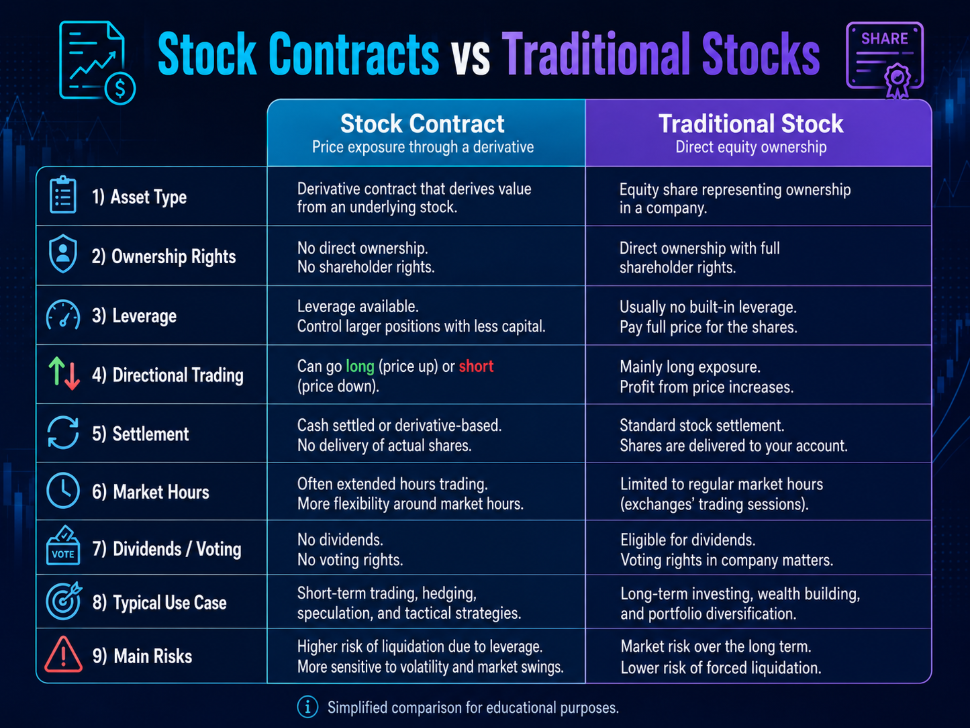
SKHYNIXUSDT or SKHYUSDT, on the other hand, are more inclined towards stock index perpetual contracts or stock-related derivatives. Its core logic is not to allow users to hold a stock-related asset, but to allow users to use USDT as margin to trade the ups and downs of SK Hynix stock or ADR-related prices. Users can go long or short, and can usually use leverage.
This means the risk structure of SKHYNIXUSDT is closer to contract trading. Its main risks include leverage magnifying losses, liquidation, funding rates, mark price deviation, insufficient trading depth, and short-term violent fluctuations. Even if you are right about SK Hynix's long-term direction, if leverage is too high and the position is too large, you may also be liquidated in short-term fluctuations.
Simply put, SKHYB is more suitable for users who want to gain SK Hynix stock-related price exposure and are interested in the RWA and tokenized stock trend. SKHYNIXUSDT / SKHYUSDT is more suitable for users with contract trading experience who can control leverage and stop-losses and want to trade SK Hynix's short-to-medium-term price fluctuations.
Therefore, newcomers must first distinguish clearly before trading: are they buying a "stock-related tokenized asset" or a "stock price contract"? Neither is direct ownership of SK Hynix stock, but the sources of risk are completely different. For SKHYB, focus more on issuance, custody, liquidity, and regulation. For SKHYNIXUSDT, focus more on leverage, liquidation, funding rates, and price deviation. KuCoin's official blog also specifically states that stock index perpetual contracts are derivatives that reference external market prices and do not represent that users own any underlying stock or security rights.
So, newcomers should remember: SKHYB is more like "buying a related tokenized security," while SKHYNIXUSDT is more like "trading a SK Hynix-related price contract with USDT."
4.3 Why Do Stock Contracts Attract Crypto Users?
Stock contracts attract crypto users for three main reasons.
First, USDT-denominated. Crypto users are already accustomed to using USDT as their unit of account and do not need to frequently convert to fiat, KRW, or USD.
Second, leverage can be used. Contract products allow users to gain greater price exposure with a smaller margin, improving capital efficiency.
Third, trading habits are close to Crypto. Order placement, take-profit, stop-loss, margin, funding rates, candlestick charts, and other operations are similar to BTC contracts and ETH contracts.
But behind these advantages lie correspondingly higher risks:
Leverage magnifies losses. Price gaps may occur between stock market opening and closing. Contract prices may deviate from the stock spot price. Funding rates affect holding costs. When liquidity is insufficient, stop-losses may not execute at the ideal price.
Therefore, stock contracts are not suitable for newcomers with no contract experience to participate in with heavy positions.
V. SKHYB Investment Value Analysis: The Dual Narrative of AI Chips + RWA
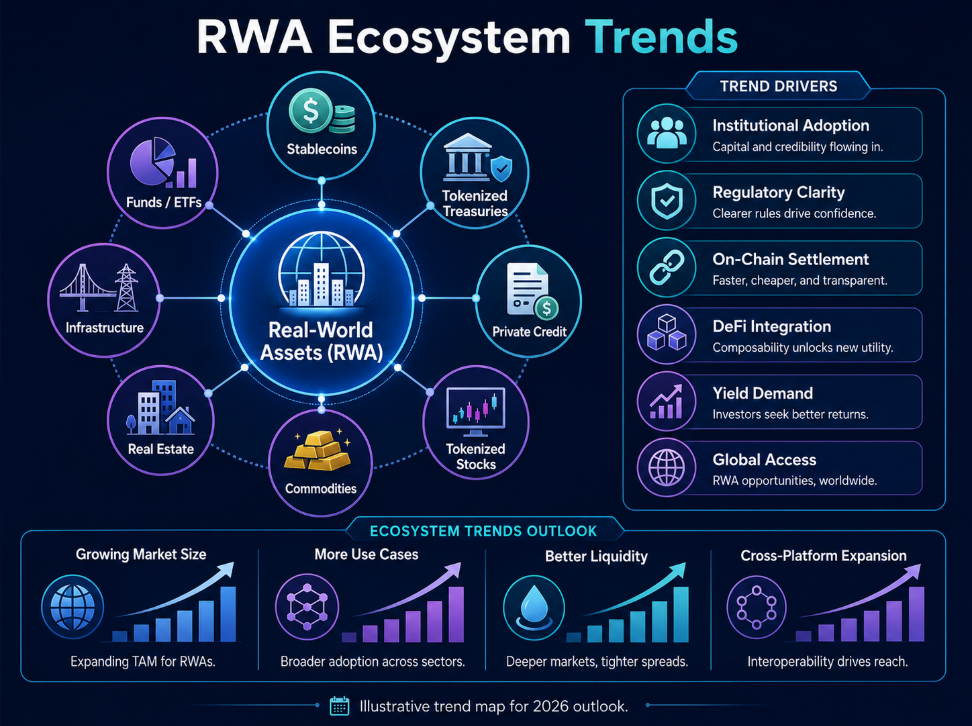
The reason SKHYB is worth paying attention to is not because it "looks like a new coin," but because it stands at the intersection of two major trends:
First, the growth of AI infrastructure. Second, the on-chain tokenization of traditional assets.
5.1 First Layer of Investment Logic: AI Infrastructure Growth
The AI industry is shifting from "model competition" to "infrastructure competition."
In the past, the market focused on who built a stronger large model and who had a better AI application. But as model training and inference costs continue to rise, the investment focus is beginning to spread to the underlying infrastructure:
GPU Servers Data Centers Power Networking HBM Enterprise SSDs Advanced Packaging
SK Hynix's core advantages lie in HBM and high-end memory. In its 2026 market outlook, SK Hynix mentioned that HBM3E is expected to remain the flagship product in the 2026 HBM market, with HBM4 gradually increasing its share. The report also cited Counterpoint Research, stating that SK Hynix maintained the top position in Q2 2025 HBM shipments, with a 62% share.
This means that if AI servers and data centers continue to expand, SK Hynix may continue to benefit from high-end memory demand.
5.2 Second Layer of Investment Logic: The RWA Asset Trend
SKHYB represents not just SK Hynix itself, but also a direction of the RWA track.
In the past, assets in the Crypto market mainly included:
BTC ETH Stablecoins DeFi Tokens Meme Coins GameFi Tokens
But after the emergence of the RWA trend, on-chain asset types began to expand to:
Stock Tokens ETF Tokens Gold Tokens Bond Tokens Fund Tokens Yield-Bearing Asset Tokens
This means that in the future, crypto users may not only buy coins on-chain, but also allocate stocks, indices, gold, bonds, and other real-world assets on-chain.
The Backed Assets official website states that xStocks are tokenized tracking certificates that track the value of publicly traded stocks and ETFs, and emphasizes that each xStock is 1:1 collateralized by the corresponding underlying asset, adopts a bankruptcy-remote structure, supports free transfer on multiple blockchains, and integrates with wallets, exchanges, and protocols.
Although the structures of different platforms and products are not exactly the same, they collectively point to a trend: traditional financial assets are migrating on-chain.
If you want to learn about other on-chain assets and USDT trading forms, you can read: What Is 01/USDT?
5.3 Third Layer of Investment Logic: Lowering Global Investment Barriers
Traditionally, investing in Korean stocks is not easy for many ordinary users.
You may need:
Overseas Securities Account Brokerage Supporting the Korean Market or ADR Trading Foreign Exchange Conversion Complex KYC Process Understanding Trading Time Zones and Market Rules
Tokenized stocks or stock contracts have transferred part of this process into the crypto platform. Users may only need to prepare USDT to gain related price exposure.
This is the appeal of SKHYB and SKHYNIXUSDT: They have turned traditional stock assets into products closer to Crypto trading habits.
But this does not mean the risks are smaller. On the contrary, in addition to bearing the stock's own ups and downs, users must also bear additional risks related to the tokenized structure, issuer, custody, trading platform, and regulatory region restrictions.
VI. SKHYB Price Factor Analysis
The price of SKHYB should not be analyzed like an ordinary altcoin. It should be judged from three levels: "underlying stock + AI industry + on-chain liquidity."
6.1 What Does SKHYB's Price Mainly Follow?
First, SK Hynix stock trend. The core price anchor of SKHYB comes from the price performance of SK Hynix-related stock or securities. If SK Hynix's stock price rises, SKHYB is theoretically more likely to benefit; if SK Hynix's stock price falls, SKHYB may also come under pressure.
Second, AI industry sentiment. AI servers, GPUs, data centers, and cloud vendor capital expenditures will all affect HBM demand expectations.
Third, the semiconductor cycle. The memory industry has a clear cyclicality. When DRAM, NAND, and HBM prices rise, corporate profits may improve. When there is overcapacity or price declines, profits may be impacted.
Fourth, crypto market liquidity. Even if the underlying stock performance is stable, if the overall liquidity of the crypto market declines, SKHYB's trading depth, premium/discount, and short-term fluctuations may also be affected.
Fifth, platform and regulatory factors. Tokenized securities often have regional restrictions, eligibility requirements, and compliance arrangements. If the platform adjusts rules, suspends trading, or restricts regional access, it will affect the user experience.
6.2 What Data Needs to Be Tracked Long-Term?
If you want to track SKHYB long-term, it is recommended to focus on three categories of data.
Company Level:
SK Hynix Financial Reports Revenue and Profit Margins HBM Revenue Changes NAND and DRAM Price Cycles Customer Structure and Order Status Capacity Expansion Plans
Industry Level:
NVIDIA GPU Shipments and Roadmap AI Data Center Construction Speed Cloud Vendor Capital Expenditures HBM3E and HBM4 Demand Memory Industry Supply and Demand Changes
Market Level:
SK Hynix Stock Trend SKHYB Trading Volume and Depth SKHYNIXUSDT Funding Rate BTC and ETH Market Cycle USDT Liquidity Changes
For newcomers, the simplest tracking logic is:
First look at SK Hynix fundamentals, then at AI industry sentiment, and finally at SKHYB's own on-chain liquidity.
VII. How to Buy SKHYB? A Complete Tutorial for Crypto Users
Below, taking platforms that support SKHYB or similar tokenized stock products as an example, we explain how newcomers can participate. The specific entry points, trading eligibility, country/region restrictions, and product rules of different trading platforms vary. Actual operations must be based on the platform page.
7.1 What Do You Need to Prepare Before Buying SKHYB?
First, prepare USDT. Trading pairs like SKHYB/USDT are usually denominated in USDT, so users need to prepare USDT first.
Second, register on a platform that supports related trading. Not all platforms support SKHYB. Even if they do, they may restrict users in some countries and regions.
Third, complete identity verification and risk assessment. Tokenized securities are different from ordinary Crypto and often involve more compliance requirements. The Binance announcement also mentioned that users need to complete account verification, and trading eligibility depends on the user's country or region.
Fourth, understand the product terms. Especially check: Is it spot? Is it a contract? Does it support deposits and withdrawals? Does it support redemption? Are there regional restrictions? Is there liquidity risk?
7.2 SKHYB Purchase Process
A standard process is usually as follows:
Step 1: Register Account Choose a platform that supports SKHYB or related trading pairs and complete registration.
Step 2: Complete Security Verification Enable two-factor authentication, complete KYC identity verification, and avoid subsequent trading or withdrawal restrictions.
Step 3: Deposit USDT Transfer USDT from another wallet or trading platform, paying attention to selecting the correct chain network.
Step 4: Search for SKHYB Search for "SKHYB" or "SKHYB/USDT" in the spot market.
Step 5: Check Trading Depth Don't just look at the price; also look at the order book, trading volume, spread, and liquidity.
Step 6: Enter Buy Amount Newcomers are advised to test with a small amount first and not to go all-in at once.
Step 7: Confirm Order Choose a market order or limit order. When liquidity is insufficient, a limit order is more recommended to control the execution price.
Step 8: View Assets After execution, confirm the holding quantity and valuation on the assets page.
7.3 If Trading SKHYNIXUSDT Contracts, How Is the Process Different?
If you are trading SKHYNIXUSDT or SKHYUSDT stock index perpetual contracts, the process will be more complex:
Deposit USDT ↓ Enter Contract Account ↓ Search for SKHYNIXUSDT / SKHYUSDT ↓ Choose Isolated or Cross Margin ↓ Set Leverage Multiplier ↓ Choose Long or Short ↓ Set Stop-Loss and Take-Profit ↓ Monitor Margin Ratio and Funding Rate
KuCoin's official explanation states that stock index perpetual contracts use a funding rate mechanism similar to crypto perpetual contracts to keep the contract price as close as possible to the underlying index price. At the same time, when the underlying stock market is closed, the index price and mark price will have special low-liquidity period handling mechanisms.
This means that stock contracts are not simply "buy and wait for it to rise." They involve funding rates, margin, liquidation, mark price, low-liquidity periods, and other mechanisms. Newcomers are not advised to use high leverage before understanding these mechanisms.
7.4 What Mistakes Are Newcomers Prone to Make When Buying SKHYB?
First, treating SKHYB as SK Hynix's official stock. This is the biggest misconception. SKHYB is not a stock directly issued by SK Hynix.
Second, only looking at the AI story, not at valuation and cycles. Strong AI demand does not mean the stock price only goes up. The semiconductor industry still has cyclicality.
Third, treating tokenized stocks as ordinary Crypto. They have additional issues such as issuer, custodian, compliance region, and redemption mechanism.
Fourth, using excessive leverage. Especially when trading SKHYNIXUSDT contracts, high leverage may lead to rapid liquidation in short-term fluctuations.
Fifth, not looking at liquidity. The trading volume of some newly listed assets is unstable, and the order book spread may be large.
Sixth, ignoring regional restrictions. Tokenized securities are often not tradable by all users globally.
VIII. SKHYB Investment Risk Analysis: Must Read
The risks of SKHYB cannot be written off as just "price volatility risk." It is a composite asset spanning stocks, Crypto, RWA, compliance, and trading platforms.
8.1 Issuer Risk
SKHYB is not an official stock issued by SK Hynix, but a tokenized security issued by a third-party structure. Users need to pay attention to the issuer's qualifications, product descriptions, compliance regions, and risk disclosures.
The Binance announcement shows that bStocks are issued by BTech Holdings Limited and are subject to specific regulatory and listing approval conditions. The announcement also notes that bStocks are only open to some eligible users and permitted regions.
If the issuer encounters operational, compliance, or credit issues, the tokens held by users may be affected.
8.2 Custody Risk
Tokenized stocks usually require underlying securities custody arrangements. Users need to care about:
Do the underlying assets actually exist? Who is the custodian? Is the custodian compliant? Is there an audit or disclosure mechanism? If the platform or issuer has a problem, how can users claim compensation?
These issues cannot be solved by project marketing slogans alone; they must be examined in specific legal documents and product terms.
8.3 Liquidity Risk
As a new asset, SKHYB may have insufficient trading depth.
Liquidity risks include:
Easy to buy, difficult to sell Excessive bid-ask spread Slippage caused by large orders in a short time Orders not executing as expected in extreme market conditions
Especially for newly listed assets, do not just look at the price change percentage; also look at real trading volume and order book depth.
8.4 Stock Market Risk
The underlying logic of SKHYB is still related to the performance of SK Hynix-related stock, so it cannot be separated from stock market risk.
Factors that may affect SK Hynix's stock price include:
Decline in AI capital expenditures Intensified HBM competition DRAM or NAND price declines Customer orders falling short of expectations Semiconductor export controls Korean market volatility Global interest rate changes Tech stock valuation corrections
Even if SK Hynix is a high-quality company, it does not mean its stock price will always rise.
8.5 Contract Trading Risk
If you are trading SKHYNIXUSDT or SKHYUSDT contracts, you must also bear additional contract risks:
Leverage magnifying losses Liquidation risk Funding rate costs Mark price deviation Price anomalies during low-liquidity periods Trading platform risk control rule changes
KuCoin's announcement explicitly warns that stock index perpetual contracts are synthetic derivatives, and trading derivatives involves significant risks, including the possibility of losing all margin.
8.6 Regulatory Risk
Tokenized stocks sit between traditional securities and crypto assets, and regulatory uncertainty is high.
Different countries and regions have different attitudes towards tokenized securities. Some platforms may allow users in some regions to trade, while others may restrict users in certain countries. The Binance announcement also explicitly states that bStocks are not available to the United States or U.S. persons, and access and trading eligibility depend on the laws and regulations of the user's region.
Therefore, users must confirm whether their location allows trading of related products before participating.
IX. What Is the Difference Between SKHYB and Buying SK Hynix Stock Directly?
The biggest difference between SKHYB and directly buying SK Hynix stock is: one is a tokenized stock asset in the crypto market, and the other is a real stock or ADR in the traditional securities market. Both may be affected by SK Hynix's stock price, but the account entry point, asset rights, trading rules, and risk structure are not the same.
If a user buys SKHYB, they usually participate through a crypto trading platform or on-chain wallet, and the unit of account is mostly denominated in crypto assets like USDT. It is more suitable for users who are already familiar with Crypto trading and want to participate in traditional tech stock price exposure with stablecoins. For such users, the advantage of SKHYB is that the trading entry point is closer to crypto habits, an overseas securities account is not necessarily required, and it is easier to integrate with on-chain asset management and RWA trading scenarios.
But it should be noted that SKHYB is not equivalent to directly holding SK Hynix company stock. Users hold tokenized assets related to SK Hynix's stock price, and the specific rights depend on the issuer, custody structure, platform rules, and local regulatory requirements. Investors need to focus on whether the issuer is reliable, whether the underlying assets have custody arrangements, whether redemption is supported, whether liquidity is sufficient, and whether the product allows users in the region to trade.
If a user directly buys traditional SK Hynix stock or ADR, they usually need to complete the transaction through a securities account, and the unit of account may be KRW, USD, or other currencies supported by the broker. Holdings in a traditional stock account are closer to direct securities assets, and the investor's rights and trading rules are mainly governed by the stock market regulatory system. It is more suitable for users who are familiar with securities accounts, want to allocate stock assets for the long term, and are willing to trade according to traditional exchange hours.
The risk structures of the two are also different. Traditional SK Hynix stock mainly faces stock market risks, such as company performance fluctuations, the semiconductor cycle, AI chip demand changes, Korean market volatility, and global tech stock valuation changes. In addition to bearing these stock-related risks, SKHYB also adds tokenization structure risks, including issuer risk, custody risk, liquidity risk, price deviation risk, platform rule changes, and regulatory uncertainty.
Simply put, directly buying SK Hynix stock is more like holding a semiconductor company's stock asset in the traditional securities market. Buying SKHYB is more like gaining an on-chain price exposure related to SK Hynix stock in the crypto market.
So, if you pursue more direct shareholder rights and a traditional securities regulatory framework, a traditional stock account is more suitable. If you are already accustomed to using USDT and crypto trading platforms and want to participate in the AI semiconductor stock market through RWA, SKHYB will be closer to your operating habits. But no matter which method you choose, you cannot just look at price ups and downs. You must first understand whether what you hold is a "stock" or a "stock-related tokenized asset."
If you just want to hold SK Hynix stock for the long term and can easily open an overseas securities account, traditional stock or ADR may have a more direct structure. If you already hold USDT in the Crypto market and want to gain exposure to an AI chip company in the form of an on-chain asset, products like SKHYB may be more in line with your operating habits.
But no matter which method is chosen, the product structure must be understood first.
X. Investment Logic Comparison Between SKHYB and Crypto Assets Like ETH and SUSHI
The most important thing for newcomers when making asset allocations is to first distinguish asset types.
10.1 What Is the Difference Between SKHYB and ETH?
ETH is a blockchain infrastructure asset. Its value sources mainly include:
Ethereum network usage demand Gas fees DeFi ecosystem Layer 2 scaling Stablecoins and RWA on-chain Staking yield and security
SKHYB is not a public chain asset. Its value core comes from SK Hynix-related stock price exposure and the tokenized security structure.
Simply put:
ETH is more like an infrastructure asset in the blockchain world. SKHYB is more like an on-chain entry point for traditional AI semiconductor stock assets.
If you are bullish on the entire Crypto infrastructure, ETH is more relevant. If you are bullish on AI memory chips and SK Hynix fundamentals, SKHYB is more relevant.
10.2 What Is the Difference Between SKHYB and SUSHI?
SUSHI is a DeFi protocol token, mainly revolving around decentralized trading, liquidity, governance, and protocol usage.
Although both SKHYB and SUSHI can be traded in the crypto market, they belong to completely different asset types and cannot be judged by the same investment logic.
SUSHI belongs to the DeFi track, corresponding to decentralized trading protocols like SushiSwap. When users evaluate SUSHI, the focus is usually on protocol usage, DEX trading volume, TVL, governance mechanisms, fee revenue, and the overall heat of the DeFi market. In other words, SUSHI's value comes more from whether the protocol itself is being used, whether liquidity is sufficient, whether the governance mechanism is effective, and whether the entire DeFi track is recovering.
SKHYB belongs to the RWA direction of stock tokenization assets. Its core is not a specific DeFi protocol, but revolves around SK Hynix stock-related price exposure, issuer structure, underlying asset custody, and on-chain trading demand. When users pay attention to SKHYB, the focus should be on SK Hynix's stock price performance, AI chip demand, HBM industry trends, tokenized stock issuance mechanisms, custody arrangements, redemption rules, and regulatory risks.
The sources of risk for the two are also different. SUSHI's main risks come from DeFi protocol competition, TVL decline, trading volume shrinkage, insufficient governance efficiency, and unstable protocol revenue. SKHYB's risks are more inclined towards the stock market and the RWA structure itself, including SK Hynix stock price volatility, issuer risk, custody risk, insufficient liquidity, price deviation, and regulatory restrictions in different regions.
Therefore, SUSHI is more suitable for users who are bullish on the DeFi recovery and are willing to research protocol fundamentals and on-chain liquidity. SKHYB is more suitable for users who are bullish on the AI chip industry, SK Hynix fundamentals, and the trend of traditional asset tokenization.
Simply put, SUSHI trades DeFi protocol value, while SKHYB trades AI semiconductor stock-related exposure. One looks at the protocol ecosystem, the other looks at the tokenization of traditional stock assets. Although both appear in the crypto circle, the investment logic and risk structure behind them are completely different.
If you want to understand the investment logic of DeFi tokens, you can read: What Is SUSHI?
XI. WALLET and SKHYB: Why Are Wallets Becoming the RWA Entry Point?
In the future, if RWA continues to develop, users will manage not only BTC, ETH, and USDT, but also stock tokens, gold tokens, bond tokens, fund tokens, and more real-world assets.
At this time, the importance of wallets will increase.
11.1 Why Do Tokenized Stocks Need a Crypto Wallet?
Wallets may play several roles in the RWA ecosystem:
First, asset management. Users can view asset balances on different chains in their wallets.
Second, identity and permissions. Some RWA assets may require KYC, whitelisting, or compliance verification, and wallet addresses may become part of the on-chain identity.
Third, on-chain interaction. In the future, some tokenized assets may be integrated with DeFi protocols, lending markets, yield products, or cross-chain infrastructure.
Fourth, asset transfer. If the product supports on-chain transfers, the wallet is an important entry point for users to manage and transfer assets.
11.2 The Role of WALLET in the Future RWA Ecosystem
In traditional finance, accounts are provided by banks and brokerages. In the Crypto world, wallets may become the user's own asset entry point.
As RWA develops, wallets may be used not only for storing coins, but also for:
Viewing Stock Tokens Managing Stablecoins Participating in On-Chain Wealth Management Connecting to Trading Platforms Verifying Identity Accessing RWA Protocols
For users new to on-chain assets, you can first learn about: What Is WALLET?
XII. What Kind of Investor Is SKHYB Suitable For?
SKHYB is not suitable for everyone.
It is more suitable for the following types of users:
First, crypto users already familiar with USDT trading. If you already know how to deposit, withdraw, spot trade, and control risk, understanding SKHYB will be easier.
Second, people who are bullish on the AI hardware supply chain. If you pay attention not only to AI applications but also to GPUs, HBM, data centers, and the semiconductor cycle, SKHYB may be a direction worth researching.
Third, people who want to get in touch with RWA assets. SKHYB can serve as a case study for understanding tokenized stocks, but it is not recommended to go heavy at the beginning.
Fourth, people who can accept complex structural risks. Tokenized stocks are not traditional stocks, nor are they ordinary Crypto. They have an additional layer of issuance, custody, regulation, and platform rule risks.
It is not suitable for the following users:
People who completely do not understand stocks People who completely do not understand contract risks People who just want to get rich quickly People who cannot bear principal fluctuations People who are unwilling to read product terms Newbies preparing to use high leverage
XIII. FAQ: Frequently Asked Questions About SKHYB
Q1: What is SKHYB?
SKHYB is a tokenized security product related to SK Hynix, belonging to the bStocks category, providing on-chain trading exposure related to the price of SK Hynix's underlying securities. It is not an ordinary cryptocurrency, nor is it a stock directly issued by SK Hynix.
Q2: Is SKHYB officially issued by SK Hynix?
No. The Binance announcement shows that SKHYB belongs to the bStocks tokenized securities issued by BTech Holdings Limited, and the announcement explicitly states that bStocks do not represent an affiliation with the issuer of the underlying asset.
Q3: Does buying SKHYB equal buying SK Hynix stock?
No. SKHYB can provide price exposure related to SK Hynix, but it does not mean you directly hold SK Hynix stock in a securities account. User rights are subject to the issuer and platform terms.
Q4: What is SKHYNIXUSDT?
SKHYNIXUSDT usually refers to a contract or trading product denominated in USDT and related to SK Hynix's price performance. Different platforms may have different names. For example, in a KuCoin announcement, the SKHYUSDT stock index perpetual contract is used, and it is stated that the contract tracks the performance of SK Hynix Inc ADR.
Q5: Is SKHYB safe?
It cannot be simply said to be safe or unsafe. It needs to be evaluated from several dimensions:
Issuer Underlying Asset Custody Platform Compliance Trading Eligibility Liquidity Redemption Mechanism Regulatory Restrictions Market Volatility
As long as it is an investment product, there is a risk of loss.
Q6: Is SKHYB suitable for long-term holding?
This depends on whether you are bullish on SK Hynix's long-term fundamentals, AI memory demand, the HBM industry competitive landscape, and whether you can accept the additional risks brought by the tokenized security structure. Before holding for the long term, it is recommended to focus on researching SK Hynix's financial reports, HBM orders, industry supply and demand, and platform product terms.
Q7: Which is more suitable for newcomers, SKHYB or SKHYNIXUSDT?
If you are a complete newcomer, you should generally understand spot products first, and then study contracts. SKHYB is more inclined towards spot tokenized securities. SKHYNIXUSDT or SKHYUSDT are more inclined towards contract derivatives, involving leverage and liquidation risks, and are not suitable for newcomers with no experience to trade with high leverage.
Q8: Will SKHYB follow the AI concept and rise?
It may be affected by the prosperity of the AI industry, but it will not necessarily rise just because of the "AI concept." It is also affected by SK Hynix's stock price, the semiconductor cycle, HBM competition, macro market conditions, and platform liquidity.
Q9: Can SKHYB replace a traditional stock account?
It cannot simply replace it. Tokenized stocks provide a new way to participate, but traditional stock accounts are more direct in terms of shareholder rights, regulatory systems, and securities holding structures. SKHYB is more suitable as an on-chain stock exposure tool, rather than a complete replacement for a traditional securities account.
Q10: What is the most important thing to look at before investing in SKHYB?
The three most important things to look at are:
First, look at the product terms to confirm what it actually is. Second, look at SK Hynix's fundamentals to confirm the underlying logic of your investment. Third, look at your own risk tolerance to avoid treating RWA assets as low-risk products.
XIV. Summary: Does SKHYB Represent the Future of Investing?
The emergence of SKHYB shows that the Crypto market is entering a new phase.
In the past, the crypto circle mainly traded native crypto assets:
BTC ETH BNB SOL DeFi Token Meme Token
And now, traditional assets are entering the on-chain market:
Stocks ETFs Gold Bonds Funds Yield-Bearing Assets
SKHYB happens to combine three hot directions:
AI ↓ Semiconductor Infrastructure ↓ HBM High Bandwidth Memory ↓ SK Hynix
RWA ↓ Traditional Stock Asset Tokenization ↓ Tokenized Securities
Crypto ↓ USDT Denomination ↓ Global Trading Entry Point
But the newer the asset, the less you can just look at the narrative. SKHYB is not a simple cryptocurrency, nor is it an official SK Hynix stock, but an attempt to bring traditional tech assets into the blockchain world. Investors must understand both the AI industry logic and the structural risks of tokenized assets.
For newcomers, the most prudent approach is not to go heavy right away, but to first complete three steps:
Step 1, figure out what SKHYB is. Step 2, understand why SK Hynix is important. Step 3, understand the risk boundaries of tokenized stocks and contracts.
Only when you simultaneously understand "AI chip fundamentals" and "RWA product structure" are you truly suited to research assets like SKHYB.
Risk Warning: This article is for educational and informational purposes only and does not constitute any investment advice. SKHYB, SKHYNIXUSDT, and related tokenized stock or contract products are subject to price volatility, issuer, custody, liquidity, leverage, regulatory, and platform rule risks. Please conduct your own research before investing and make decisions cautiously based on your personal risk tolerance.